EAS Curriculum
Our program, curriculum and assessment system has received the highest possible rating of 4 stars from Parent Aware.
Parent Aware is the organization that rates the quality of childcares in Minnesota.
-
The goal of every educator is to help their students learn. For a child to learn they must be interested, be able to recognize some control, and be able to reflect. To facilitate these effectively an educator, the teacher must build trust with their students. Most people know that it is easier to work with children who are interested in learning the material and luckily many studies support this understanding (Dahliani & Rahmatan, 2020; Permatasari, 2019; Prasetya, 2018; Rajasekaran & Kalyani, 2018). Being interested, or becoming fascinated, in something creates the desire to understand what that thing is and how it works (Doyle, 2011). Far too often children are subjected to being taught what someone else –their parents, or teachers, or cultural expectations, etc.– are interested in having them learn. For the most part only lip service is given to letting a child explore their interests. Even when this is allowed, the space and materials that children are given to explore their interest’s in are so manicured that they foster very little opportunities for true exploration, or creativity.
The Ely Adventure School believes in the work of Maria Montessori and Carolyn Pratt, and we work to foster the genuine engagement that their schools of thoughts allow. People try to reach out and seize control almost regardless of what that control really is (Zull, 2002) and here we work to give children real opportunities to find control in their own learning. Not all children even know that what to do when they are given this type of autonomy in their own learning, (Doyle, 2008) but with an educator as support each child can begin to understand their own abilities providing much more impactful education (Doyle, 2011; Pratt, 1948; Sobel, 2015; Zull, 2002). Finding what one is interested in and being able to recognize some control one has are both critical parts of the learning process, yet they are not technically learning. Reflection is. Kolb (1984) outlined learning elements that Zull (2002) later connected to the physical makeup of the brain. This model begins with a concrete experience, then reflective observation, followed by an abstract hypothesis, and finally active testing. The lack of interest removes any power that concrete experience has while also limiting observations (Christakis, 2016; Dahliani & Rahmatan, 2020). Without reflective observation, and reflection, learning cannot happen. The child will keep having experiences but never grow beyond the person they were the last time they reflected and learned (Medina, 2008). Without the control to engage in active testing, ideas cannot be seen through to their fruition and learning will have no meaning (Christakis, 2016; Ramstetter, 2010).
With all of this pedagogy, the Ely Adventure School teaches, social and emotional skill building, problem-solving and critical thinking skills, and healthy physical skill development. We believe that these things will help any child, anywhere, find success.
-
Create a warm, safe, and nurturing climate where children feel valued and accepted unconditionally as important members of our classroom community.
Establish relationships with a sense of trust and security in the classroom: child-child, child-teacher, and teacher-teacher.
Establish routines, rules, and guidelines in the classroom that are clear and consistent.
Encourage and support autonomous/independent action and thinking: problem-solving, decision-making, and self-help skills.
Create opportunities for children to initiate and sustain play with a variety of peers and develop friendships, learning strategies for social problem solving and dealing with conflict.
Facilitate children’s development and use of play skills (initiating play, maintaining and extending play, turn-taking, negotiation, and compromise).
Guide children toward increases in positive self-control, the ability to tolerate frustration, and social cognition.
Facilitate children developing a positive self-concept, self-worth, and competence.
Increase children’s awareness and ability to identify, and appropriately express their own feelings and emotions.
Promote children’s willingness to try new experiences and take social and emotional risks.
Develop children’s empathetic awareness of others’ feelings, understanding of how one’s actions and words affect others, and how to respond appropriately to the needs and feelings of others.
Facilitate children’s emerging awareness and positive acceptance of their own and others’ gender, ethnic identity, and culture.
-
Foster in children a love of learning and a willingness to take intellectual risks.
Facilitate children’s ability to attend and persist in cognitive tasks, develop their working memory and cognitive flexibility (i.e. executive function skills).
Encourage children to engage in exploring, touching, manipulating, investigating, questioning, and discovering the world around them.
Facilitate children’s interaction with materials and people, constructing knowledge and developing higher-order thinking skills, which lay the foundation for specific academic skill acquisition.
Provide an environment rich in concrete objects, materials, and hands-on experiences so the children will have opportunities to gain first-hand knowledge and build meaning through the use of the five senses.
Support children’s ability to relate observations, experiences, ideas, and feelings to others through conversations, dramatic play, painting, modeling, construction, and creative movement.
Encourage children’s engagement in beginning mathematical, logical, and scientific higher-level thinking skills: 1:1 correspondence; matching/discriminating; part/whole relationship; quantifying (more/less, some/all, many/few, counting, etc.); grouping; classifying; ordering; observation skills; predicting; hypothesizing; cause/effect relationships; conserving; convergent/divergent thinking; measurement; spatial concepts; time concepts; and remembering/recalling.
Increase knowledge of and abilities to use symbolic and representational systems such as numbers, alphabet letters, signals, signs, gestures, and facial expressions through engaging in role-taking as well as using dramatic play props, art media, blocks, books, paper/pencils, etc. to recreate or stand for another object or event.
-
Support children in becoming competent language users by expanding vocabulary and awareness of words, expanding the use of expressive language and mature speech patterns, and increasing listening and receptive skills.
Encourage the social use of language through discussion and exploration of ideas, conversations, stories, games, and music experiences.
Facilitate the ability to use language for various forms of communication: expressing needs, asking questions, getting and giving information, establishing and maintaining relationships, expressing feelings/thoughts/emotions, interpreting and reasoning about events, creating imaginary scenes, and playing with words and sounds.
Establish awareness and beginning facility with the written words, phonemic awareness and the relationship between speech and print.
-
Encourage children to enjoy and enthusiastically engage in physical activities in both indoor and outdoor environments designed for large motor activity.
Expand and enhance children’s physical abilities in fine motor coordination such as manual dexterity, eye-hand/eye-finger coordination, and object manipulation/control through increased participation and skill in activities such as using writing utensils, cutting with scissors, stringing beads, placing pegs in holes, etc.
Expand and enhance children’s physical capabilities in large motor coordination: walking, running, jumping, hopping, pedaling, throwing, catching, kicking, climbing, and dancing.
Develop children’s physical fitness: balance, coordination, endurance, strength, flexibility, and perception.
Facilitate children’s management of relaxation and calming techniques to soothe themselves.
Provide opportunities for children to become aware of and comfortable with their bodies: labeling parts, identifying functions, learning how bodies move through space, and participating in movement activities for enjoyment and creativity.
Help children develop a willingness to take safe physical risks.
-
Facilitate children’s curiosity and enjoyment of investigating new/unfamiliar situations, people, and materials.
Facilitate children’s expression of unique and individual thoughts, ideas, and feelings through self-expressive, open-ended materials and activities, including, but not limited to, drawing, painting, sculpting, modeling, singing/playing musical instruments, moving/dancing.
Encourage children’s interest in and enjoyment of fantasy and imaginative play.
Foster novel use of resources and enjoyment of responding creatively to problems while reinforcing independent thinking and individuality.
Increase children’s flexibility in thinking about events, materials, activities, and people by trying new things, making a guess, creating new ideas, etc.
Encourage children’s enjoyment and expression of humor.
-
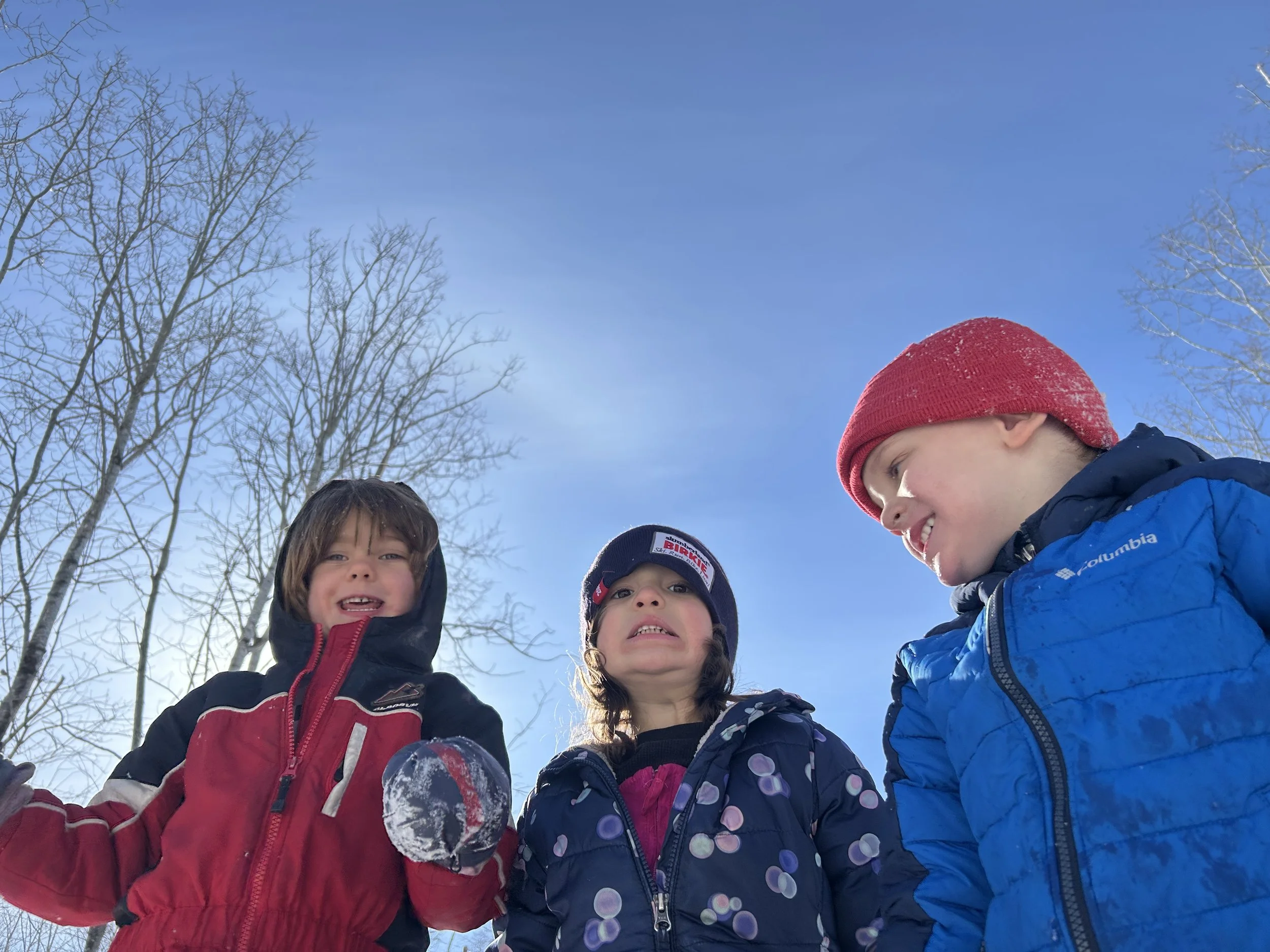
At the Ely Adventure School, we spend at least 40% of our day outside in all but the most inclement weather. Our school is situated on about 5 acres of forest. Our main outdoor classroom is located between our driveway and a power cut. This bit of forest helps provide clear boundaries for children at the same time as providing wonderful large and fine motor skill building opportunities. The woods have both open areas and densely paced vegetation creating nice pathways. With a mix of both deciduous and coniferous trees, phonology is an ever-present lesson! In the summer we have tons of raspberries, blueberries, and even strawberries. Birds make their nests in our outdoor classroom and we have watched a number of baby chicks being raised. The rocks and trees provide an endless source of building templates and martials. In the fall, the leaves make crinkly piles for us to play in. Our hoop house is still producing the last of the vegetables, such as squash and tomatoes, and the colder weather helps children practice putting on jackets and mittens. The winter brings piles of snow prime for building and sculpting, Children can perfect their skills in getting dressed for the outdoors and animals tracks are everywhere for us to follow and explore what animals do. Spring comes, and we are able to watch the amazing process of the world turning green again but before that happens, we tap the trees and collect sap to cook down into maple syrup! Also, we have endless mud. I don’t think I need to explain more.
We have several outdoor class spaces. Each has its own personality, and we rotate between them depending on the day. Each outdoor classroom has a name, most of which the children give. They are: The upper classroom, the lower classroom, The Big Rock, the Hazelnut fort, the Underworld, and Robin rock.
Our indoor classroom meets all the requirements set by the Department of Human Services. It is a large open area that has many toys, manipulatives, building blocks, puppets, books, and a craft zone (We have a craft area outside too depending on weather). There is a large mud room for children to hang up outdoor clothing and we have two bathrooms. Lots of big windows that go low enough for children to look out of and to bring in natural light and indoor climbing equipment is available for children to practice the skills they use in outdoor play as well.
-
It does not take long when working with people, children especially, to learn that even the best laid plans can fall apart. This does not need to be bad though. The wonder and curiosity that children bring can lead us down new paths of exploration with learning that even us educators have not anticipated (Montessori, 1995; Pratt, 1948; Sobel, 2013). Being able to work towards the goals we have for children, defies any oversimplified path that a lesson plan attempts to outline. What we believe at the Ely Adventure School is consistent, regular, and frequent review of the goals we, as educators, are working towards helping our students achieve, reflection of how our techniques are supporting our students and reaching those goals, and fostering our own creative but genuine style of teaching.
Engaging in this process daily, if not hourly, does represent significant effort on the part of an educator. That being said, it is our belief that this style of education vastly reduces the feeling of routine mediocrity and stagnation. In other words, burnout among our teachers. For example: Imagine a lesson plan for creating silly animals through arts and crafts. For the lesson materials you have lots of colored paper, crayons, feathers, googly eyes, buttons, beads, popsicle sticks, scissors, glue sticks, etc. One of the goals of the lesson plan is to have children practice motor skills using scissors and placing beads or googly eyes on glue. The other goal is to have children think about and identify some features of how animals adapt to the environments they live in. Maybe even beforehand, the teacher made an example animal on a background they drew so their students can get an idea of what the project could look like. It seems like a pretty fun lesson to me. It supports a few of the goals we are looking for in child development and education. What this lesson plan and many like it forget is that there are a whole lot of experiences at the edges and between the different aspects of this lesson. Who is setting up the craft? Who is cleaning it up? What if one child has mastered the scissors and trades their skill for someone who has figured out the glue stick and they work together? Are they still reaching the goals we have set? Have they discovered new depth to this project that is just as important if not more so? What if every student copies the example presented? Have they accomplished the goals of the lesson then? What about the student who glued 40 popsicle sticks on top of each other but was super excited about doing that?
With those questions in mind I present this approach: at all times as educators we are working towards helping children find joy in learning and be excited about pursuing their own interests all while maintaining a strong community.
-
Approaches to learning: Inquisitiveness
Inquisitiveness is a natural part of outdoor play. It does not matter how large the budget is, or how attentive and caring a teacher is, a classroom cannot compete with the sheer diversity of any outdoor space. Every square inch of ground can be turned over and examined. Every stick is another loose part that engages curiosity, and facilitates dramatic play. Hundreds of questions can be discovered every second. Watching birds land on the ground, seeing a new plant, feeling snow land on one’s cheeks, getting feet wet from a puddle, observing a worm move, and countless other areas of investigation. With simple modeling from an educator, or even a slightly older child, students can engage in genuine inquisitiveness. This means that as educators we get down on our hands and knees, or even on our bellies, in the dirt. We let out students know that what they discover is important and has value by being interested in their discoveries.
The Arts: Self Expression
Access to art materials at any time gives children an outlet to create something that feels important to them at that time. Whether it’s in addition to a game, such as a menu, coded letter, a picture to put in the house or a representation of their family, a method for thinking about a real challenge they’re having at home, a picture of a dog they want, the children are able to view self-expression as a part of their normal life and daily routine, embedding it into their thoughts and process. Having a specific time for art is excellent and often helps children become comfortable with new skills and get to see new ideas. Having art supplies available always, allows them to use it as an effective tool of self expression. Once again, with simple modeling from an educator, or even a slightly older child, children can try out self expression through art.
Cognitive: Comparing Numbers and Quantities
When outside in the natural world, our senses are bombarded with so many things that require us to learn to categorize. Here, we also engage in activities that inherently include the concepts of comparing numbers and quantities. In the Spring we tap maple trees for sap. We gather it up into 5 gallon buckets and we pour them into our 32 gallon holding container. When that is full, we cook it down and we end up with about half to three quarters of a gallon of syrup. We then device that into smaller containers for easier transportation and storage. In just this one activity children are surrounded by opportunities to compare numbers and quantities. The same can be said for finding sticks to build a fort, organizing stones into patterns, peeking into a bird nest to see the eggs, and countless other activities.
Physical Movement Development: Locomotion
The outdoor world provides a myriad of opportunities to practice locomotion. Moving up and down inclines, climbing up on top of a rock, hopping off of the rock, hanging from low branches on a tree, laying down on a belly to crawl under a fallen log, and many more opportunities. I occasionally joke that moving through our outdoor space is better than most gym classes. Children are excited to explore and engage with the landscape we have. Although we don’t always set up intentional obstacle courses, the environment presents many challenges that children don’t typically face in their lives at home. One of the big rules we have here at the Ely Adventure School is that we don’t help children climb. If a child wants to climb up something they can try but they will not receive other than verbal support and maybe suggested ideas of how to move their body. A staff member will certainly be nearby, especially if it is a new challenge the child is attempting and will offer support if the child were to fall. Unsurprisingly though, when this rule is applied, children rarely find themselves in places that are too scary for them. If they have to work to figure out how to get there, then they know how to get back down as well.
Social and Emotional Development: Building Relationships
Social skills are a huge aspect of what we teach at the Ely Adventure School. This type of work is extremely important in a world where social skills have been largely forgotten and replaced with social media, emphasis on academics above all else, and the lack of unstructured free time for children. Here, not every second of the day is scripted or planned out in advance. Free play is part of our daily curriculum intentionally. Dramatic play is encouraged and modeled by educators as well as peer to peer interaction. This consistent feature, of unstructured time, in our day leads to all sorts of necessary experiences for building friendships; including, identifying similar interests, compromising, inviting others to play, asking to play with others, conflict resolution, game creation, teamwork towards a common goal, and so many other aspects that happen naturally as we form relationships with others.
Language of Development and Communication: Social Conversation
With our emphasis on building social skills at the Ely Adventure School language becomes a critical aspect for children to understand an practice. Being able to communicate ideas is critical when developing a game with peers. When a mistake happens our educators work with a child to have them explain what they think happened and how it could’ve been avoided or what they could do differently in the future. This guided reflection requires children to practice social conversation as a skill. At first, it is challenging. It requires patience, and not saying too much on the part of the educator. Once the child understands some basic aspects of conversation, they often start to feel much more comfortable, explaining their thoughts and feelings. From this point on educators can continue to introduce new vocabulary for emotions into conversations with students and continue to value their ideas and opinions.
-
Families are a critical resource for educators to acknowledge and work with. At the Ely Adventure School, drop off and pick up time is intentionally used to communicate with families about where their child is at, what has happened in the past 12 hours that we need to be aware of, or they need to be aware of, sharing plans for the day, and communicating overall goals of the week. This is a great way to leave space for families to ask questions and for educators to share ideas to continue education at home.
Although most families send their children to our school because all adults at home are busy with work during the day, parents and grandparents of children are welcome to come and volunteer at school or just observe. During this time they are welcome to ask questions, and when available the Director or lead teacher will be able to chat and answer them. Parents have fun ideas of things they’d like to bring to the program are encouraged to do so, and the Director will communicate with him about how best accomplish the activity or program.
Parent conferences happen at least twice a year, but both parents and teachers can request an additional meeting if they feel it is important.
-
Above, we listed a number of goals we work towards at the Ely Adventure School. Something to keep in mind is that our curriculum is learner centered. This means that we are not interested in creating a clear step-by-step procedure that is followed to provide good education, and we do not believe that a clear step-by-step procedure provides adequate education for any child. Often curricula laid out in such a way to look nice, and give others an idea of what teachers are working towards, but in practice have very little to do with actual education taking place. People, children especially, are not computers (Guirguis, 2018; Keltner, 2024; Lukianoff & Haidt, 2018; Sax, 2016; Williams, 2016, 2017). Every child is a unique Individual needing different aspects of education, despite age, background, or any other innumerable factors. That being said, we work on three things here at the Ely Adventure School: social skills, critical thinking skills, and physical skills. Each area has its own progression, and often there is overlap and transferable qualities. To succeed in any of these children must be interested in what is happening, able to recognize some sort of control they have, and be able to reflect. Our educators foster these three things to help children learn, and enjoy the process of growing and learning.
Social skills:
Some children arrive at our program, comfortable with communicating with words and actions, others do not. Some children come able to encounter challenges and stress without losing complete control of their actions, others do not.
For some children working towards the goals of encountering challenges, while handing some control of their actions, and being able to communicate with words and actions are the first goals we work towards. Even the children who are able to do these things often have proficiency in certain areas, but lack proficiency in others. Here is a shortlist of things we work on with all children. These are skills that we believe most adults still work on as well. They are all important.
Respect: of oneself, others, equipment/ buildings, the natural world
Ownership of one’s actions: when you make a mistake, own it, when you do something great, be proud.
Apologizing: Just saying sorry is not enough. We examine how to approach someone when we need to apologize to them, as well as being specific in what it was for our own benefit and for theirs.
Clear communication: Taking the time to collect one’s thoughts. Trying one’s best to use words or descriptive actions to communicate.
Critical thinking skills:
There is an undue and completely unfounded emphasis on academics in Preschool and early childhood education in general (Christakis, 2016; Medina, 2008; Sax, 2016; Sobel, 2013). That being said, children are spending everyday trying to understand the world around them. They are testing out new ideas and confirming previously held ones. As educators we can scaffold their learning by helping them to dig into new critical thinking problems. For some children a new problem is an amazing new thing that they have to try and solve. For these children, we as educators have to make sure we do not get in their way whenever possible. If it is time for snack but some child or a group of children is deep into exploring a concept, then it is our job as educators to let that continue and shift the schedule a bit. For many children, we can also lead by example and try out new ideas in front of them that they have not yet thought of to help them come up with more ideas on their own, especially when they are stalling out.
Unfortunately, many children today are used to having adults do everything for them that is even a little bit challenging or frustrating; such as putting on shoes, opening snack wrappers, zipping zippers, etc. Often as educators of children we have to encourage them to try out new and challenging things. Show them an idea and then have them replicate it. Convince them the reward of completing the challenge is worth it and they will get the hang of it so fast!
Instead of focusing on academics, at EAS we focus on the critical thinking skills which are essential for all academic skills, and learning. Far better to know and understand how something works, then to be able to recite by, rote, the same fact.
Physical Skills:
Children are sitting far more each day than they ever have before (Allen et al., 2018; Doyle, 2011; Keltner, 2024; Sax, 2016; Williams, 2017). The human body is not designed to do this well especially with children who are developing so fast. Sitting so much leads to a myriad of problems (Burdette & Whitaker, 2005; Carson, 1956; Medina, 2008; Sax, 2016; Sobel, 2013, 2015; Veiga et al., 2016; Whitebread, 2017; Williams, 2016, 2017; Zull, 2002). Here at EAS, we learn to move. Just walking through our outdoor classroom provides more physical education than children get on any regular day at school. Learning to walk between young saplings, hop from rock to rock to avoid puddles, or even jump with two feet to create a big splash in a puddle are all valuable skills. Balancing, hand eye and foot eye coordination, climbing, moving quickly and carefully, moving slowly and deliberately all happen naturally in an outdoor environment. One can’t sneak up on a baby bunny if they’re unaware of how their own body moves.
At the end of the day we teach physical skills here mostly through inherent interaction in our program. We don’t need to focus on it, mostly because every child who comes here encounters challenging, physical activity. We also see huge improvement even in just a few short weeks.
At EAS, we meet children where they’re at. We offer an abundance of unstructured free play opportunities to practice a huge range of skills that are developmentally appropriate. Children here primarily engage with things they can, and do, encounter in their daily lives. The biggest difference here is that we do this all with intention. The intention to help children grow, learn, and thrive.
-
With our focus on individual exploration, effective teamwork and social skills, and a learner centered curriculum, we at EAS have the ability to work with a wide range of learning differences. Due to where we are located, it is uncommon for us to have students who are not fluent in English. That being said, every child who comes here receives individual attention specifically to help them to find success here. For some that might be, language learning skills. Often, we work on these skills anyway because not all three-year-olds, or any children have solid proficient language skills. Someone who speaks limited English here would just require more intentional focus. (In my experience, other children do extremely well communicating and understanding across language barriers far better than most adults.)
For children with learning differences, EAS also offers unique programming ability. Many children these days are diagnosed with some sort of attention disorder. I would argue that it is far more likely that these children are just subjected to boring, non-stimulating, environments where they have no control and their skills are not valued enough (Sax, 2016; Sobel, 2013; Williams, 2017). It is not our place here to make a diagnosis, or refute previous diagnosis. That being said, many children, with his attention disorders, do not display any signs of them here.
As for other learning differences, our program’s ability to address each child individually, focus on learning that makes sense to them and for them, and build a relationship with children allows us to at least consider working with any child and any learning difference. It is definitely possible that our program is not the right place for a child, and if this is the case, parents will be consulted to help figure out the next best steps.
-
Allen, K., Kern, M. L., Vella-Brodrick, D., Hattie, J., & Waters, L. (2018). What Schools Need to Know About Fostering School Belonging: A Meta-analysis. Educational Physiological Review, 30, 1–34.
Burdette, H. L., & Whitaker, R. C. (2005). Resurrecting free play in young children: Looking beyond fitness and fatness to attention, affiliation, and affect. Archives of Pediatrics & Adolescent Medicine, 159(1), 46–50. https://doi.org/10.1001/archpedi.159.1.46
Carson, R. (1956). Help Your Child to Wonder. Women’s Home Companion, 7, 24–48.
Christakis, E. (2016). The importance of being little. Penguin Books.
Dahliani, E. R., & Rahmatan, H. (2020). The correlation between students’ interest and learning outcomes in biology. Journal of Physics Conference Series, 1460(1), 012072.
Doyle, T. (2008). Helping students learn in a learner-centered environment. Stylus Publishing.
Doyle, T. (2011). Learner-centered teaching: Putting the research on learning into practice. Stylus Publishing.
Guirguis, R. (2018). Should we let them play? Three key benefits of play to improve early childhood programs. International Journal of Education and Practice, 6(1), 43–49. https://doi.org/10.18488/journal.61.2018.61.43.49
Keltner, D. (2024). Awe: The new science of everyday wonder and how it can transform your life. Penguin.
Kolb, D. A. (1984). Experience as the source of learning and development. Prentice Hall.
Lukianoff, G., & Haidt, J. (2018). The Coddling of the American Mind: How Good Intentions and Bad Ideas Are Setting Up a Generation for Failure. Penguin Press.
Medina, J. (2008). Brain rules: Principles for surviving and thriving at work, home, and school. Pear Press.
Montessori, M. (1995). The absorbent mind. Henry Holt.
Permatasari, B. D. (2019). The influence of problem based learning towards social science learning outcomes viewed from learning interest. International Journal of Evaluation and Research in Education, 8(1), 39–46.
Prasetya, S. P. (2018). Effect of learning media variation to increase interest and learning outcomes of geography. Advances in Social Science, Education and Humanities Research, 212, 558–561.
Pratt, C. (1948). I learn from children: An adventure in progressive education. Simon and Schuster.
Rajasekaran, K., & Kalyani, D. (2018). Innovative teaching and learning. Journal of Applied and Advanced Research, 3(1), S23–S25.
Ramstetter, C. (2010). The Crucial Role of Recess in Schools. Journal of School Health, 80(1).
Sax, L. (2016). Boys adrift: The five factors driving the growing epidemic of unmotivated boys and underachieving young men. Basic Books.
Sobel, D. (2013). Beyond ecophobia: Reclaiming the hart in nature education (Second). The Orion Society.
Sobel, D. (with Stires, A., Bailie, P., Finch, K., & Kenny, E.). (2015). Nature preschools and forest kindergartens: The handbook for outdoor learning. Redleaf Press.
Veiga, G., Neto, C., & Rieffe, C. (2016). Preschoolers’ free play—Connections with emotional and social functioning. International Journal of Emotional Education, 8(1), 15.
Whitebread, D. (2017). Free play and children’s mental health. The Lancet Child & Adolescent Health, 1(3), 167–169.
Williams, F. (2016). This is Your Brain on Nature. National Geographic, 49–65.
Williams, F. (2017). The nature fix: Why nature makes us happier, healthier, and more creative.
Zull, J. E. (2002). The art of changing the brain: Enriching the practice of teaching by exploring the biology of learning. Stylus Publishing.